
AI-Powered Cyber Threats in 2026: What MSPs Must Prepare For
The Cyber Threat Landscape Has Entered a New Era
The cybersecurity landscape in 2026 has changed dramatically, and AI-related cybersecurity threats are now a serious reality for Managed Service Providers (MSPs). Artificial intelligence is no longer just a defensive tool; cybercriminals are using it to automate attacks, create advanced phishing campaigns, and evade traditional security systems. These evolving threats are forcing MSPs to rethink their security strategies to better protect the organizations they serve.
According to current cyber threat predictions, businesses are increasing security investments to combat AI-driven risks. This makes adopting strong MSP cybersecurity best practices more important than ever. Proactive monitoring, AI-powered threat detection, zero-trust frameworks, and clear client communication are essential steps. MSPs that adapt quickly will strengthen client trust, improve resilience, and stay competitive in the rapidly evolving threat landscape of 2026.
This guide provides MSP decision-makers and cybersecurity professionals with a deep-dive into the AI-powered threat landscape of 2026, the cyber threat predictions driving enterprise security budgets, and the actionable MSP cybersecurity best practices needed to build genuine resilience.
AI's Dual Role in Cybersecurity: Attacker and Defender

Artificial intelligence doesn’t take sides; it empowers whoever uses it best. In 2026, cybercriminals are rapidly adopting AI to launch smarter and faster attacks. Through AI-as-a-service platforms, even low-skilled attackers can automate vulnerability scans, generate highly convincing phishing emails, create self-modifying malware, and use deepfake technology to impersonate executives. With machine learning models optimizing attack timing, AI cybersecurity threats in 2026 have become more accessible and dangerous than ever. The biggest concern is the democratization of these tools, expanding the threat landscape far beyond nation-state actors.
At the same time, AI is significantly strengthening cyber defenses. Defensive AI tools for MSPs now offer behavioral anomaly detection, AI-driven SIEM correlation, automated incid1ent response (SOAR), predictive risk scoring, and advanced phishing detection using NLP. These technologies reduce response times and improve accuracy, but they don’t replace human expertise. Instead, they enhance it. MSPs that treat AI as a force multiplier, combining intelligent automation with skilled analysts, will build stronger, more resilient security operations in 2026.
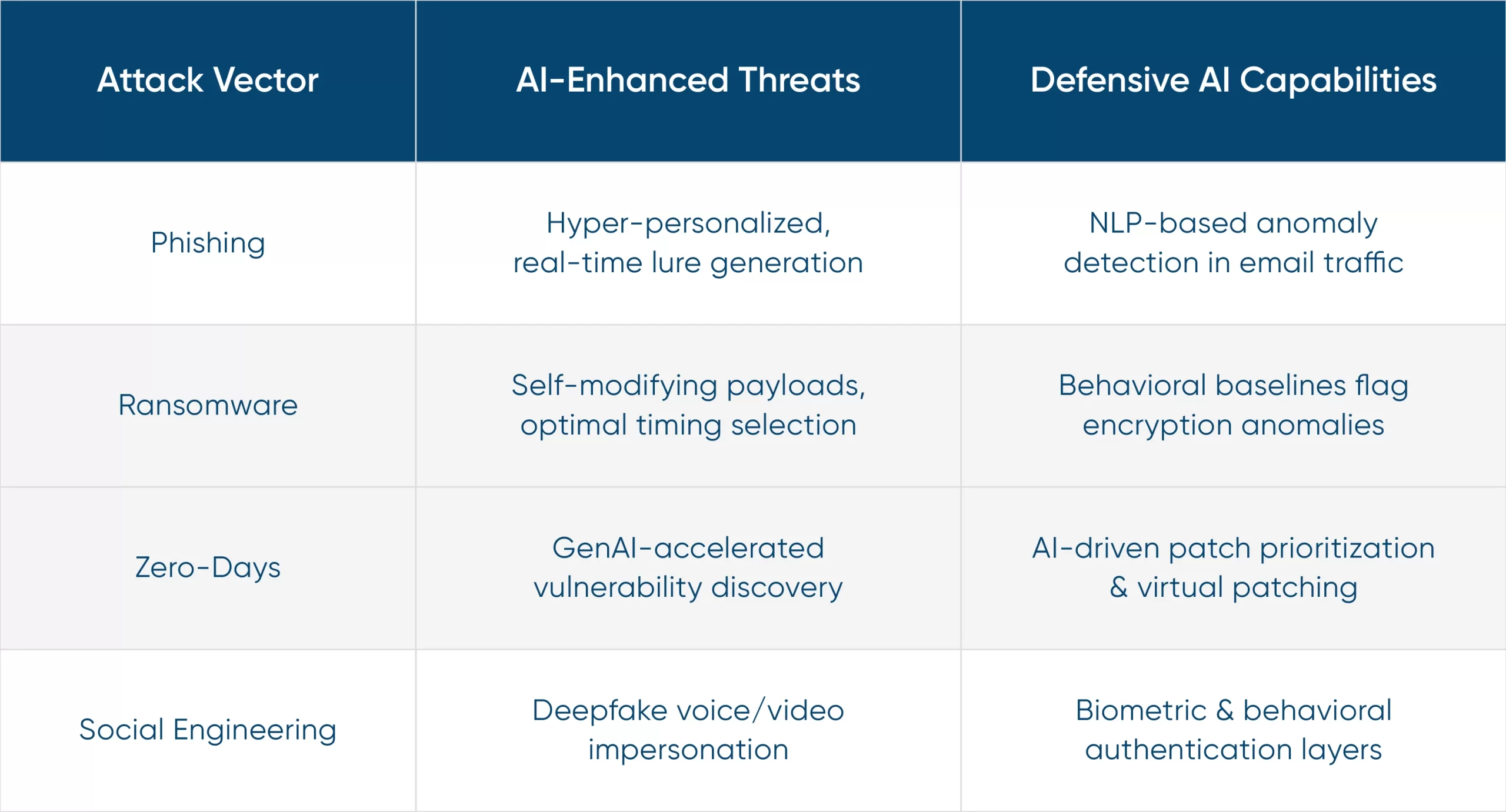
AI Threat vs. Defensive AI: Head-to-Head Comparison
Top AI-Powered Threats MSPs Must Prepare For in 2026
In 2026, AI cybersecurity threats are smarter, faster, and more dangerous than ever. MSPs face four main AI-enhanced attack types:
- AI-Driven Ransomware – Automatically chooses high-value targets, adapts to security defences, and spreads intelligently across MSP client networks. Poorly segmented environments are especially vulnerable.
- Phishing Automation – AI crafts highly personalized phishing and BEC attacks using public data, reaching clients through email, SMS, voice, and collaboration tools. MSP staff handling finance or vendor access are prime targets.
- Adaptive Malware – Self-modifying malware evades traditional antivirus and EDR tools by rewriting code, detecting sandbox environments, and hiding malicious activity. Behavioral detection is now essential.
- Generative AI Zero-Day Exploits – AI rapidly finds and exploits software vulnerabilities, including MSP tools like RMM and PSA platforms, reducing the time between disclosure and attack to hours.
MSP Cybersecurity Preparedness
MSPs need a layered, proactive approach combining technology, process, and people:
- Defensive AI Tools – Use AI-powered EDR/XDR, SIEM, and email security platforms with behavior-based detection and automated response. Prioritize multi-tenant compatibility and transparent AI models.
- Proactive Threat Hunting – Establish behavioral baselines, use UEBA for anomalies, and leverage threat intelligence to detect attackers early. Consider co-managed SOC or MDR services if internal capacity is limited.
- Zero Trust Architecture – Enforce MFA, least-privilege access, microsegmentation, and continuous verification for users, devices, and MSP tools.
- SIEM + SOAR Best Practices – Implement multi-tenant SIEM, automate threat triage, use MSP-specific SOAR playbooks, and integrate with PSA/ticketing systems for fast, coordinated response.
By combining AI-powered defense with skilled analysts, MSPs can protect clients, reduce risks, and stay ahead of AI-driven threats in 2026.
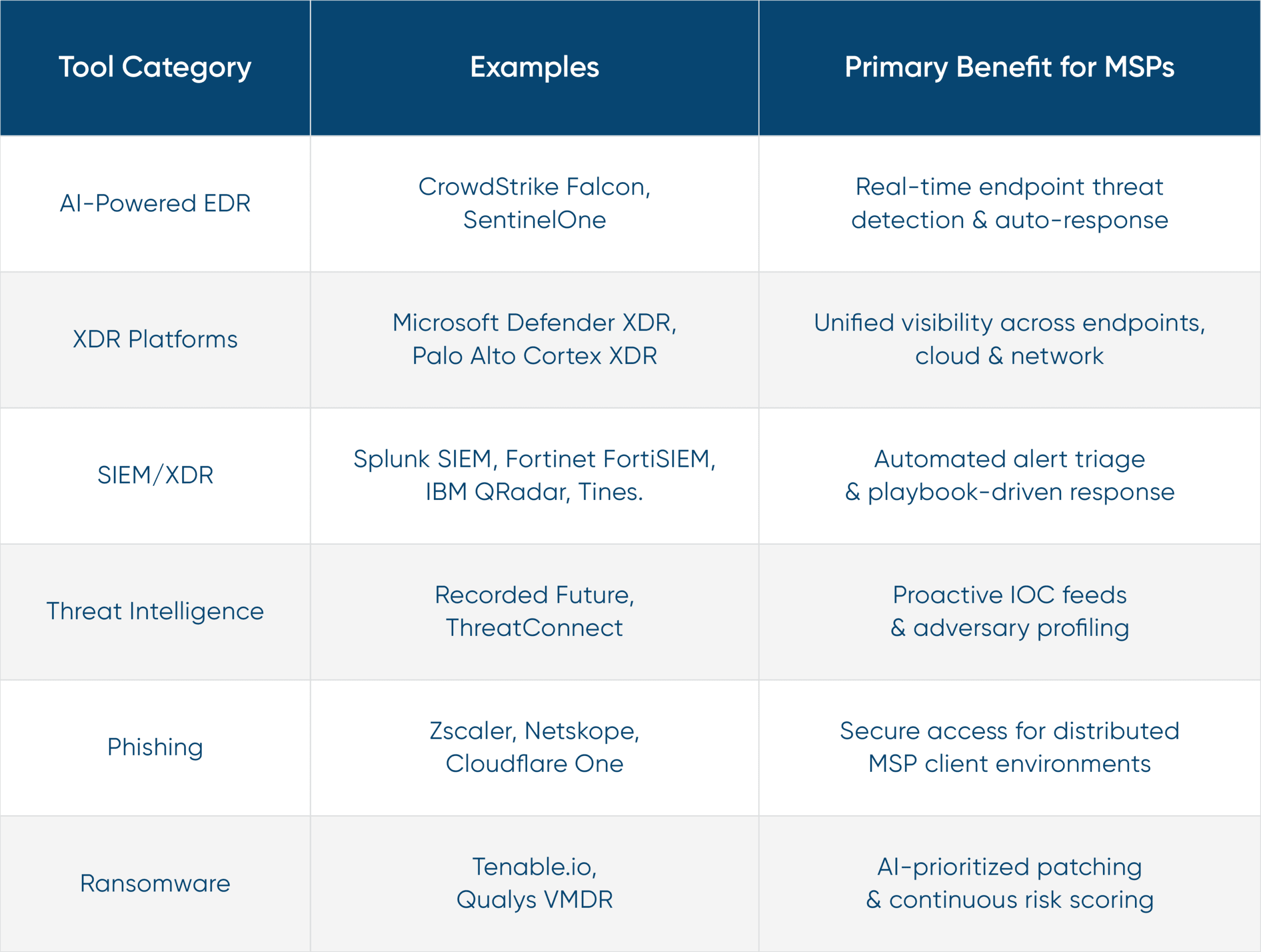
Tools and Technologies MSPs Can Leverage in 2026
Building a 2026-ready security practice requires assembling a technology stack that can address AI-enhanced threats across the full attack surface. The table below summarizes the key tool categories, leading solutions, and primary benefits for MSP environments.
Conclusion: Preparing for the AI Cyber Threat Era
The rise of AI cybersecurity threats in 2026 marks a critical turning point for MSPs. A single breach can quickly spread across multiple client environments, causing financial loss, reputational damage, and operational disruption. However, the same AI technologies empowering attackers can also strengthen defences when applied strategically. MSPs that treat cybersecurity as a core business priority—rather than an afterthought—will differentiate their services and earn long-term client trust.
To stay ahead, MSP leaders must adopt AI-powered threat detection, protect RMM, PSA, and remote access tools with Zero Trust and behavioral analysis, and implement proactive threat hunting to reduce attacker dwell time. Multi-layered defences against phishing and BEC, including AI-driven email security, user training, and dual-authorization, are essential. A robust multi-tenant SIEM + SOAR system, enforced MFA, least-privilege access, and clear incident response plans create true cyber resilience. For organizations seeking a reliable partner to navigate this complex landscape, Flexis stands out as a leading outsourced IT service provider, helping MSPs implement advanced security strategies and safeguard their clients in the AI-driven threat era.
Share this article
Share this article
For more information
Nick Blozan
VP Sales & Marketing